
MEDIA STATEMENT
Spotlighting the harms and accountability gaps in the Lesotho Highlands Water Project (LHWP) Phase II. Maseru, Lesotho | 2 March 2026
The Lesotho Highlands Water Project (LHWP) is a treaty-based, transnational water export and hydropower project established under the 1986 Treaty between Lesotho and South Africa. In practical terms, the project exports water from Lesotho’s Highlands to South Africa’s industrial and commercial hub, financed largely by South Africa, while Lesotho generates hydroelectricity and earns royalties that are significant to its economy alongside mining revenues. Two implementation agencies operate on either side of the border: the Lesotho Highlands Development Authority (LHDA) and South Africa’s Trans-Caledon Tunnel Authority (TCTA). The project is co-financed by development finance institutions (DFIs) including the African Development Bank (AfDB), the New Development Bank (NDB), and the Development Bank of Southern Africa (DBSA), alongside private sector investors.
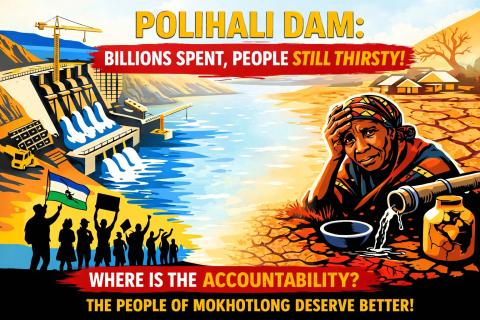
LHWP Phase II, initially set to commence in 2011, faced major delays to a start time in 2019 and is now scheduled for completion in 2028. Phase II includes the approximately 165-metre high Polihali Dam and a 38-kilometre transfer tunnel linking the Polihali reservoir to the Katse reservoir in Mokhotlong District. The project’s cost escalation has become a central public-interest issue: Phase II was originally budgeted at ZAR 8 billion in 2008 (approximately ZAR 19 billion in inflation-adjusted terms) and has since ballooned to around ZAR 53.3 billion. Given that the project relies on public finance, these costs raise questions about transparency, value for money, debt exposure, and opportunity costs for critical public services such as healthcare and education.
Evidence compiled on LHWP Phase I and Phase II indicates a consistent pattern of adverse impacts that require urgent attention. Reported harms associated with LHWP Phase II include unfair evictions and relocation of indigenous communities from traditional lands; inadequate, delayed, and gender-blind compensation for loss of land, livelihoods, and communal resources; extensive environmental degradation including damage to water sources and other natural resources that communities rely on; and increased risks of sexual and gender-based violence linked to the labour influx associated with construction, including migrant labour. These impacts have been described as falling disproportionately on women, girls, and other vulnerable groups, with gendered effects prominent across both Phase I and Phase II.
Accountability concerns extend beyond impacts to the adequacy of safeguards and remedy. The project is financed through public resources, yet oversight is reported to be limited despite significant project fees associated with the implementing agencies. Recourse and remedy mechanisms are described as weakly implemented and, in some cases, effectively inaccessible in practice. We further note claims that the AfDB has failed to uphold and implement its own Integrated Safeguards System in relation to LHWP Phase II, and that DFI safeguard commitments, including gender policies where they exist, do not reliably translate into project-level outcomes. In addition, the NDB is cited as being slow to implement safeguards and as lacking a dedicated gender policy, despite sustained civil society calls.
The concerns raised are not unique to LHWP, but reflect broader, recurring risks associated with mega-infrastructure projects co-financed by DFI consortia across the Global South. The treaty underpinning LHWP has come under increased political scrutiny in South Africa, including calls for review and updating of its terms, debates that may affect future royalty flows and, by extension, Lesotho’s economic security.
The Civil Society Forum of the New Development Bank (CSF), AFRODAD and the Seinoli Legal Centre call for immediate, measurable action by the Governments of Lesotho and South Africa, LHDA and TCTA, and all financiers supporting LHWP Phase II to ensure effective access to project information, meaningful consultation processes with affected communities, and gender-responsive measures that protects the rights and livelihoods of women, girls and vulnerable groups. We further call for fair and timely compensation of affected communities, robust and enforceable environmental and social safeguards, and credible grievance and remedy pathways throughout the full project cycle, from early planning and design through construction and completion, alongside transparent public reporting on financing, costs, and debt implications.
“Development cannot be measured only by concrete poured or loans secured. It must be measured by whether communities are safer, livelihoods are stronger and whether rights are protected. Communities wanting accountability must not be perceived as anti-development. In fact, it is what makes development legitimate.” ~ Mosa Letsie, lawyer, Seinoli Legal Center
“The project costs jumped from ZAR 8 billion to ZAR 53 billion. South Africa deepens its debt, while Lesotho bears non‑economic costs that are not calculated; reduced grazing land, increased gender-based violence and HIV-infections, deepening inequality and poverty. Development can’t mean dispossession. Shutting the public out of recourse mechanisms, fuels ballooning debt and weakens the social contract.” ~ Riska Koopman, Policy Research & Advocacy Officer, Int. Public & Private Finance, AFRODAD
“Without fair compensation, the project imposes huge economic costs on affected communities. Women and girls have been excluded from consultations, leaving them overlooked in project design and decision-making processes. There is a high prevalence of gender-based violence; infrastructure is not gender neutral, and when safeguards are weak or poorly enforced, the costs of mega-infrastructure projects become extremely high.” ~ Marianne Buenaventura Goldman, Project Coordinator, Finance for Development, FORUS
Media contact: riska@afrodad.org
Resources: NDB Fact Sheet / Lesotho Documentary, Press Briefing Recording
The Civil Society Forum of the New Development Bank (CSF) is a network of civil society organisations (CSOs) based in South Africa and the Southern African region. Working in partnership with civil society and academic actors across BRICS countries, the CSF engages the New Development Bank, including its African Regional Centre, and other development finance institutions to strengthen their responsiveness to the needs and rights of communities. The CSF advocates for enhanced transparency, meaningful stakeholder participation, and robust accountability frameworks. The CSF supports development finance that advances gender equality, environmental sustainability, and inclusive, pro-poor growth, while contributing to long-term social and economic transformation.
AFRODAD is a Pan-African Civil Society organization that champions for responsible borrowing and lending; increased public participation in debt governance; and equalisation of power between creditor and debtor country governments in Africa.
The Seinoli Legal Centre (SLC) is an independent legal centre that leverages the Rule of Law to protect, restore, and enhance the sustainable livelihoods of local communities affected by large-scale development projects.