
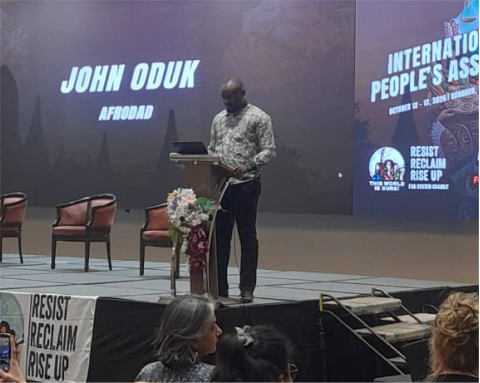
Statement of Solidarity on behalf of Debt and Financial Justice Movements: Reclaiming Our Future Beyond the "Compromiso de Sevilla"
We gather at a historic flashpoint of compounding global crises: where predatory debt architectures, unchecked corporate power, private bondholder obstruction, and rising war economies are systematically looting the Global South. While dominant financial institutions and exclusive creditor clubs continue to protect a broken status quo that prioritizes profit over people and the planet, communities on the frontlines, disproportionately bearing the brunt of climate breakdown, austerity, and economic violence, demand an immediate end to systemic injustice.
1. The Crisis of Unsustainable Debt and Systemic Injustice
- Almost half of humanity—3.3 billion people—live in countries that spend more on debt payments than on essential public services like health and education.
- This unsustainable and illegitimate debt burden acts as a colonial instrument used by creditor-driven systems (such as the G20, IMF, and World Bank) to exercise economic and political power over the Global South.
- This crisis is heavily compounded by private bondholders, commercial creditors, and holdout creditors who consistently obstruct transparent and effective debt restructuring and is further worsened by continued illicit financial flows, including large-scale international tax abuse by corporations and wealthy individuals which drain critical public resources away from developing countries.
- This crisis is heavily compounded by a global war economy, escalating armed conflicts, trade wars, and soaring military budgets, while official development assistance (ODA) and international cooperation are severely slashed.
- These structural injustices are deeply rooted in an inequitable global financial architecture that concentrates decision-making power in undemocratic institutions.
2. Rejecting the Compromise of the Status Quo
- The adoption of the Fourth International Financing for Development Conference outcome document (FfD4), “Compromiso de Sevilla" represented a severe compromise on the ambition needed to address the urgency of our times, sidelining civil society and protecting a status quo that benefits wealthy nations and corporations.
- Creditor countries stripped the outcome document of its remaining ambition on debt, ultimately culminating in the European Union and other wealthy states disassociating from paragraph 50 (f) of the outcome statement which states in part, “.......we will initiate an intergovernmental process at the United Nations, with a view to making recommendations for closing gaps in the debt architecture and exploring options to address debt sustainability .......:
- We refuse to accept this trajectory as inevitable. The job is not yet done; we view the outcomes of Sevilla not as a ceiling, but as a baseline starting point to relaunch true structural transformation.
- The regional debt context across Africa, Asia, Latin America and in developing countries across the globe is not merely an issue of financial illiquidity, but a systemic crisis where debt service routinely overrides basic human rights and climate resilience.
- Severe debt servicing, compounded by non-concessional loans, heavy domestic obligations, and automatic budget allocation rules crowds out crucial health, social, and climate adaptation spending, forcing communities (especially women) to absorb the costs of debt servicing and climate disasters unassisted.
3. Core Demands and Actions for Debt and Financial Justice
To break free from financial imperialism and build an emancipatory economic agenda, we demand:
- Broad Reforming of the Global Financial and Economic Architecture: Beyond focus on a UN Framework Convention on Debt, we demand deep, holistic structural transformations across global monetary, trade, tax, and financial governance to dismantle the colonial legacies enshrined in the global economy.
- Accelerating Tax Reforms to Launch the Debt Track: We must accelerate international and domestic tax reforms, including the effective implementation of the UN Framework Convention on International Tax Cooperation to curb illicit financial flows in all their forms, plug massive revenue leakages, and secure the vital public resources necessary to underpin and initiate comprehensive debt relief and resolution through a UN Convention on Sovereign Debt.
- Centring Feminist Political Economy: Feminist political economy offers indispensable insights into how macroeconomic regimes invisibilise and exploit social reproductive labour, showing how alternative policy frameworks can redistribute resources, recognise care work, and democratise economic decision-making. In this sense, heterodox and feminist approaches are not peripheral add-ons but essential foundations for building sovereign, just, and life-affirming economies.
- Binding Principles, Automatic Relief, and Restraining Bondholders: The architecture must establish binding principles of responsible lending and borrowing, major jurisdiction legislation to limit and compel private bondholders and holdout creditors who obstruct debt restructuring, and automatic debt service cancellation mechanisms to protect countries from extreme economic, climate, and health shocks.
- Decisive Measures to Curb Illicit Financial Flows (IFFs): We demand immediate, decisive, and systemic measures to combat and eliminate IFFs in all their forms, including a central public database for country-by-country reporting and global registries to stop large-scale tax abuse by corporations and high-net-worth individuals.
- Challenging Illegitimate Debt and Conditionality: We call for new approaches to debt sustainability frameworks (DSAs) aligned with human rights and gender/environmental audits to identify and cancel illegitimate, illegal, and odious debts, while eliminating harmful loan conditionalities like public sector wage caps and budget cuts.
- Challenging the War Economy and Militarization of Aid: We reject the diversion of development cooperation toward security and defence objectives, demanding instead that record military spending be redirected toward public services, social infrastructure, and environmental resilience.
4. A Call to Action and Solidarity
- Democratizing global economic governance requires strengthening democratic multilateralism centred around the United Nations while widening our social base through grassroots and mass movement solidarity.
- As we approach major mobilisation moments aimed at delegitimising dominant financial institutions, civil society movements on debt, tax, climate, trade unions, and grassroots networks, and others must stand united now more than ever.
- We refuse to defend a broken system and will continue fighting for an international financial architecture that serves people and the planet over profit.
Viva debt justice viva!
Viva tax justice viva!
Viva climate justice viva!
John Oduk, Policy Officer, Executive Director’s Office