- Home
-
About Us
- Our Journey
- Our Organisation
- Our Team
- Board of Trustees
- Theory of Change
- Opportunities
- Partners
- Strategic Priorities
- Strategic Plans
- Resources
- Flagships
- Campaigns
- News & Events
- Contact Us
- Popular Corner
Press Briefing - 39th Summit of the African Union

Event Details
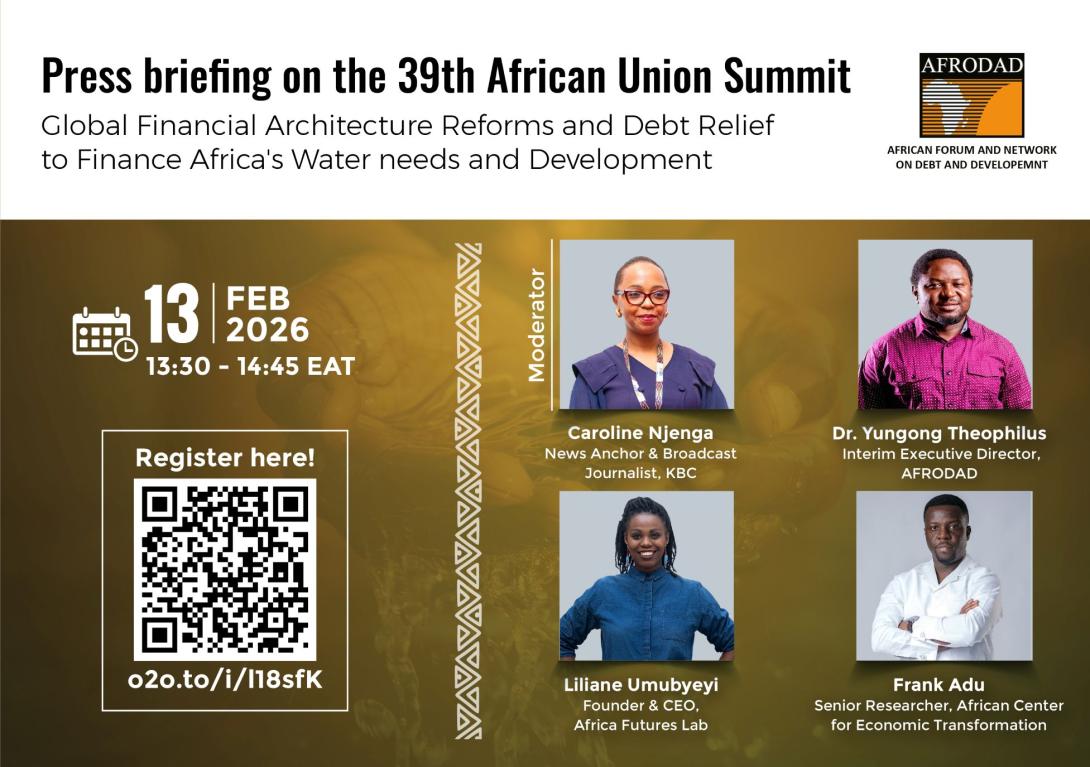
**VIRTUAL MEDIA ADVISORY**
PRESS BRIEFING ON THE 39TH SUMMIT OF THE AFRICAN UNION
Friday, 13 February 2026
13:30–14:45 EAT
Live translation into French will be provided
As Severe Drought Devastates East Africa,
Experts Demand Urgent Reforms for Debt Relief, Clean Water Access
Calls come on the sidelines of 39th African Union Summit,
where water and debt relief are a major focus
As 4.6 million East Africans suffer through a humanitarian crisis brought on by severe drought, African heads of state are gathering at the African Union Summit in Addis Ababa to debate critical financial and development reforms, including with regard to safe water access.
More than 400 million Africans lack access to clean drinking water, a basic human right. The urgency of this challenge has prompted the African Union Commission to declare 2026 the year of ensuring sustainable water availability and safe sanitation systems across the continent.
The G20 Common Framework was meant to enable faster and fairer debt restructuring for low-income countries, yet it has proven to be both inadequate and highly inefficient. A recent study revealed that the framework has relieved just 7% of the total value of external debt owed by at-risk, lower-income countries. Moreover, the sharing of responsibility between public and private creditors is deeply unequal. Ethiopia arrived at a draft restructuring deal in January 2026, but that deal has been blocked by the Official Creditors Committee, which said the deal failed to meet the Common Framework’s Comparability of Treatment principle.
In this context, leading experts from African civil society will host a media briefing to detail the need for debt solutions that enable long-term investment in public goods, including water. The experts will stress the need for the establishment of a UN Framework Convention on Sovereign Debt, as well as other fair and transparent reforms that recognise Africa’s vulnerabilities and development priorities. They will speak to the urgency of amplifying Africa’s collective voice on water security, debt sustainability, and the need for international solidarity and partnership.
What: Press briefing on the sidelines of the 39th African Union Summit: Financing Water for Life and Development through Debt Relief and Global Financial Architecture Reforms
When: 13 February 2026, 13:30–14:45 EAT
Where: Zoom (virtual) - Register here
Who: Speakers at the briefing will include:
- Caroline Njenga, News Anchor & Broadcast Journalist, KBC
- Dr. Yungong Theophilus, Interim Executive Director of AFRODAD
- Liliane Umubyeyi, Founder and CEO of Africa Futures Lab
- Frank Adu, Senior Researcher at the Africa Center for Economic Transformation (ACET)
Why: The 39th Ordinary Session of the Assembly of the African Union is gathering under the theme of “Assuring Sustainable Water Availability and Safe Sanitation Systems to Achieve the Goals of Agenda 2063.” This briefing will highlight the continent’s mounting debt burden and how reforms to the global financial architecture and comprehensive debt relief can unlock long-term investment in water resilience and development. The event will articulate priorities from the Lomé Declaration (2025) and the Common African Position on debt ahead of the Summit and emphasise the urgency for a UN Framework Convention on Sovereign Debt.
Notes to editors:
- Africa faces severe water access and infrastructure deficits. Roughly 411 million people lack basic drinking water services across the continent; Sub-Saharan Africa alone is home to over 387 million people who live without safe water.
- Africa’s public debt challenges include $2.14 trillion in public debt (~60% of GDP), rising debt servicing costs, and constrained public investment in water and other public goods. External debt payments are projected to reach $90 billion in 2026.
- The Lomé Declaration (2025) calls for global financial architecture reform, a UN Framework Convention on Sovereign Debt and reparations as part of correcting historical injustices.
- The G20 Common Framework remains highly inefficient. Chad applied for debt restructuring in January 2021, but only reached an agreement two years later – when a surge in oil prices rendered it no longer necessary. Similarly, Zambia sought debt treatment in February 2021 but only signed a Memorandum of Understanding with its bilateral creditors in April 2024.