- Home
-
About Us
- Our Journey
- Our Organisation
- Our Team
- Board of Trustees
- Theory of Change
- Opportunities
- Partners
- Strategic Priorities
- Strategic Plans
- Resources
- Flagships
- Campaigns
- News & Events
- Contact Us
- Popular Corner
Southern-led Global Debt Strategies

Event Details
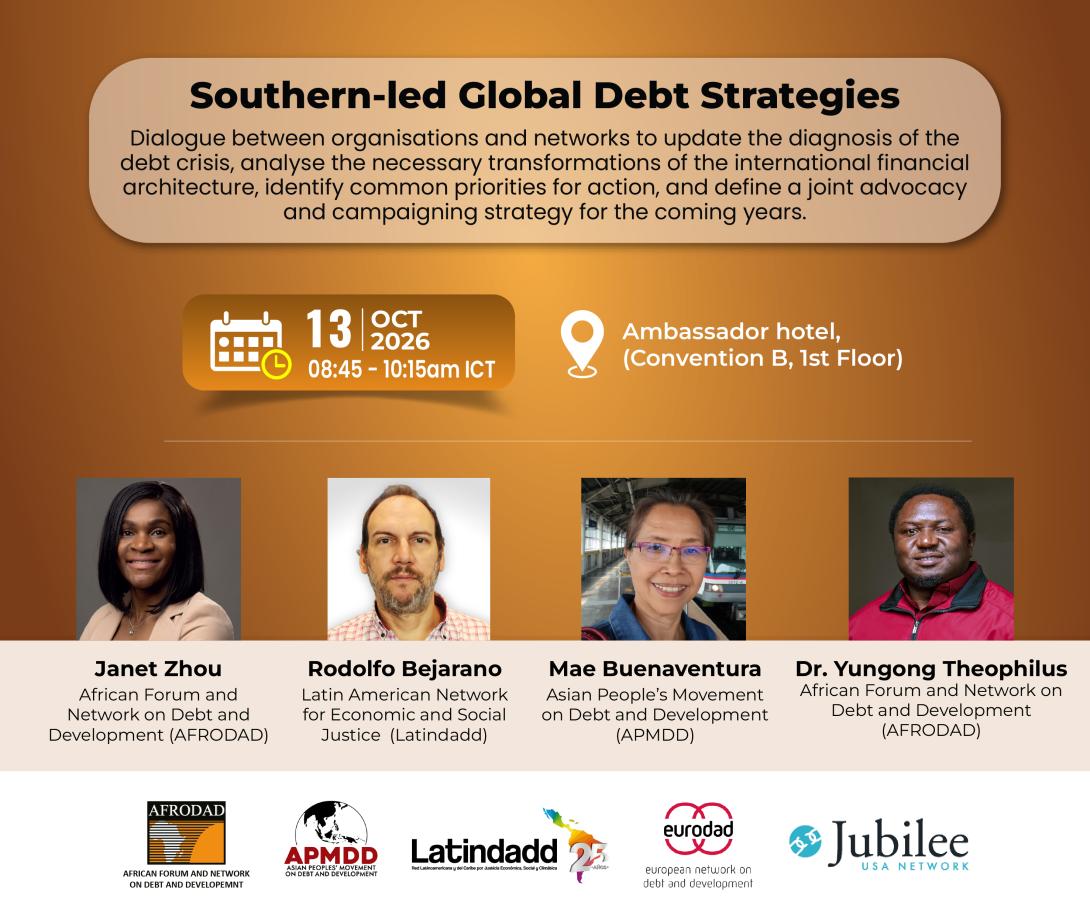
Southern-led Global Debt Strategies
A political southern-led space for dialogue between organisations and networks around the world in order to: update the diagnosis of the debt crisis; analyze the necessary transformations of the international financial architecture; identify common priorities for action; and define a joint advocacy and campaigning strategy for the coming years.
Date: Tuesday, 13th October 2026
Time: 08:45 am - 10:15 am Indochina Time (GMT+7)
Venue: Ambassador hotel, (Convention B, 1st Floor)
Co-organisers: AFRODAD, APMDD, Latindadd, Eurodad, Jubilee USA
Background
Countries in the Global South are facing the worst debt crisis and are grappling with increasingly limited fiscal space, while their development prospects are hampered by the diversion of essential resources to debt service payments. The high cost of financing, the growing burden of debt, the conditionalities imposed by international financial institutions, and the lack of coordinated global efforts to cancel illegitimate debts and provide real debt relief keep many countries in a state of permanent vulnerability. At the same time, a new context of increasing armed conflicts and the constant threat to multilateralism was being observed.
The current financial architecture and its governance needs a radical transformation to end the debt trap and safeguard the sovereignty of countries in the Global South, thus allowing to guarantee rights, address the climate crisis, and finance sustainable development.
In September 2023, civil society and the debt justice movement had the opportunity to meet in Bogotá at the first Southern-led Debt Strategy Meeting that allowed networks and organizations from Latin America, Africa, and Asia, along with allied organizations from across the world, to advance a common diagnosis and a shared actionable agenda. Then, in January 2026, a second meeting was held in Manila, where the dialogue and exchange continued on the opportunities and challenges that arose after the Fourth International Conference on Financing for Development, which resulted in the Seville Commitment. In particular, advancing on the proposal for a UN Framework Convention on Sovereign Debt and the call for debt cancellation after the Jubilee year.
Now, in the sidelines of the IMF/World Bank Annual Meetings in Bangkok, and building on the results of previous meetings, there is an opportunity to continue this process and review and update a common political agenda and a coordinated advocacy strategy for the debt community, led by Global South perspectives.
The new international scenario has brought to the forefront issues relevant to the transformation of the financial architecture, many of them arose from the Seville agreements, including: the Borrowers' Platform, the Principles for Responsible Lending and Borrowing, an intergovernmental process at the United Nations on debt architecture, new allocations of Special Drawing Rights, reform of credit rating agencies, etc. All of this framed within the demands from civil society to achieve the implementation of a United Nations Framework Convention on Sovereign Debt and a transformation of international financial institutions, which makes it especially pertinent to strengthen the coordination of economic, social, gender and climate justice movements.
The session will take advantage to present a photography exhibition with the topic “Eyeing the Debt” and to project the videoclip of the song “Who owes who?”.
Agenda
- Welcome and Context Setting
- Current Debt Context in 2026: Perspectives from the Global South (10’)
- Opportunities and Challenges for a New Financial Architecture
- Common Priorities of the Global South, Areas of Influence and Concrete Actions (45’)
- Next Steps
Guiding questions for 45’ session on common priorities
- Where do we influence first? Which debt demands and spaces should the Global South prioritise over the next 12 months: intergovernmental process or Borrowers’ Platform or G20?
- What should be our common ask for the 2nd UNGA Committee and which governments or groups (e.g. G77, Africa Group, etc) can support this ask? Who in this room can approach which delegations, governments, etc?
- What kind of outcomes do we expect from the Borrowers’ Platform? What are our non-negotiables and how best can this space be used?
What is our joint debt-climate-reparations action/position for COP31 which is in a few weeks? - What can each of us commit to from the common priorities we have discussed?